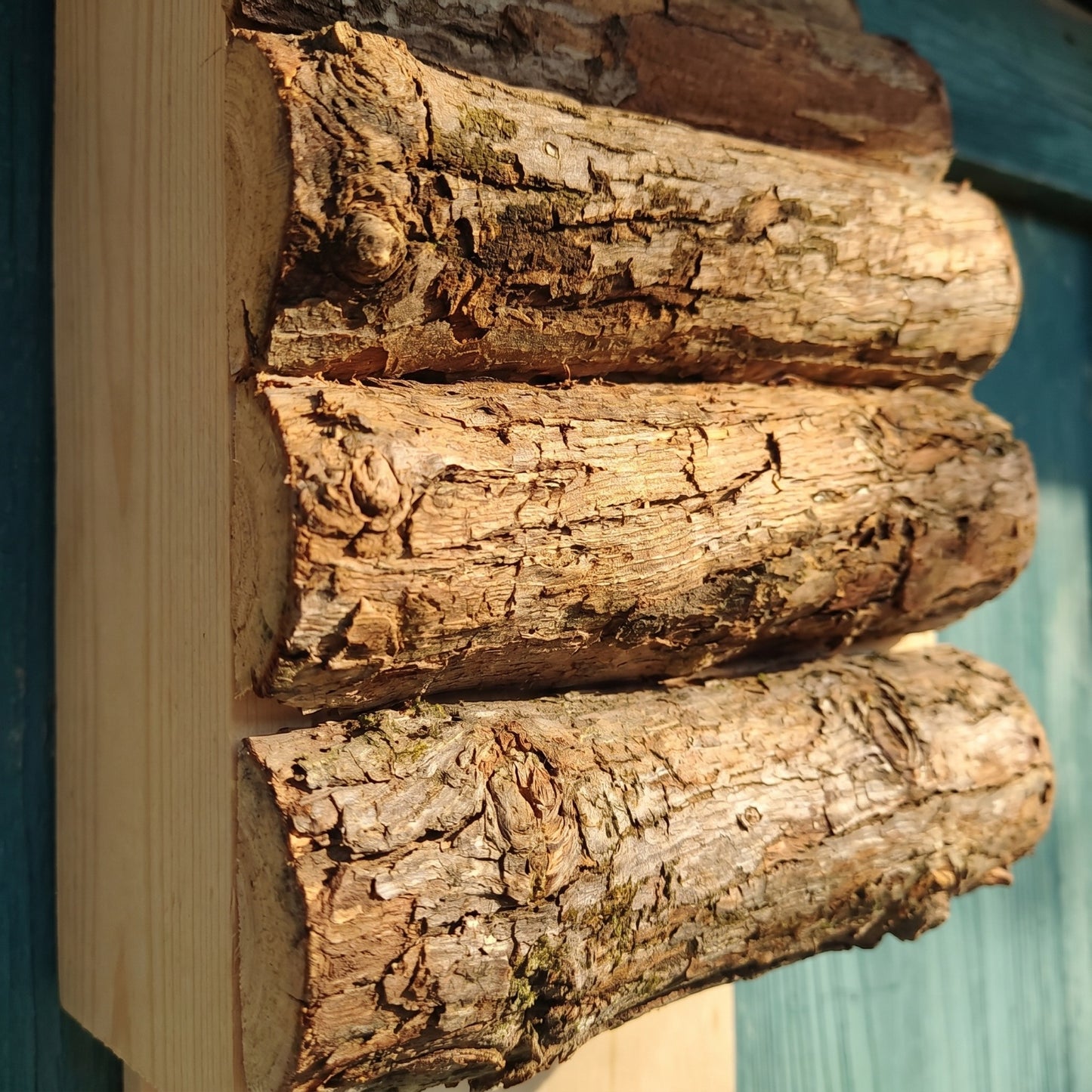
Malcolm's Hand-Built Bat Box
Malcolm's Hand-Built Bat Box
🐝 Gives wild bees a safe nesting home
🌸 3× more pollination than honeybees
🪵 Solid, untreated cedar — built to last
☔ Copper roof keeps tunnels dry
🌿 Chemical-free, natural materials only
Couldn't load pickup availability

Malcolm's Hand-Built Bat Box
Hand-Built in the Stroud Valleys, Gloucestershire
Malcolm Reeve, seventy-two — forty-four years a Cotswold roofer, and thirty-four Junes counting the same chapel colony. He took their roosts off for a living. These are the roosts he is putting back. 68 left, and no second batch.
“Everybody builds them a little house with a little front door. They don’t want a door — they want a crack.”
What arrives at your door
Why a colony moves in — and a garden-centre box hangs empty for years
Thick, solid, untreated timber — no zinc, no tar, no felt, no dark coat. The mass holds a steady temperature through a July afternoon instead of climbing into the range that finishes a nursery in a thin box. “I spent forty years keeping roofs cool and dry,” Malcolm says. “Same job. Smaller.”
Inside is a crack, not a room. The grooves are cut tight enough that the animal’s back and belly both touch wood at once — the pressure that tells it it is safe. Most boxes give them an open chamber, and an open chamber reads as exposed ground.
A bat never goes in at the front. It lands low, then climbs up through the open bottom — exactly the way it would go up under a slate. The gaps you can see between the logs are structure, not doorways. Getting this one thing wrong is why so many boxes never get used.
No membrane, no weave, no fabric, no loose fibre anywhere on it. Research by the University of Reading with the Bat Conservation Trust found that non-woven breathable roof membranes pose an entanglement risk to bats. Malcolm builds the deliberate opposite: solid timber and bark, nothing a claw can pull free.
Fallen oak and sweet chestnut off the valley floor — two of the few British timbers that last outdoors with nothing at all put on them. No stain, no preservative, no sealant. Nothing to off-gas, and nothing the animal has to breathe in a sealed cavity all day.
Drawknife, brace and mallet instead of a router. Slower, quieter, and no cracked seams to open in the first wet winter. Every box is cut, bored and grooved by Malcolm himself — about two days of work in each one, and no second batch once the stack is gone.
“People picture bats in caves, but in a British summer the females gather in warm day roosts to raise a single pup each — and in this country those roosts are almost always in buildings. Re-roofing, loft conversions and barn conversions have quietly removed an enormous amount of that habitat, and the insect supply has fallen at the same time. A good box replaces what has been lost, but only if it gets three things right: thick untreated timber that will not overheat, entry from the open bottom, and a rough grooved interior they can grip. Get those wrong and it either cooks or stays empty. Put one up on a warm wall and you are doing something genuinely useful — recovery here happens one pup at a time.”
Dr Helen Marsden, Bat Ecologist
Severn Vale Bat Ecology Group
Perfect for
Quality you can check yourself
- Thick, untreated timber — holds a steady temperature through the summer instead of cooking the colony inside.
- Open-bottom entry — the safe, predator-resistant way bats actually use a roost, not a decorative front hole.
- Rough, grooved interior — bark-on timber and hand-cut grooves give them something to climb and hold.
- Nothing loose or woven — no membrane and no fibre anywhere a claw could pull it free.
- Final batch, built by hand — every box is made by Malcolm himself. Once the stack is gone, there is no restock.
30-Day Money-Back Guarantee
Put it up on a warm wall and live with it for a few weeks. If it arrives not as described, or it simply is not right for your spot, send it back within 30 days for a full refund. One email is all it takes — and UK delivery is free.
A note on handmade variation and wild tenants: Every box is cut and finished by hand from natural logs, so grain, bark, colour and small marks vary from one to the next — that is the mark of real handwork, not a fault. And bats are wild. Sited properly — a warm south or south-east facing wall, 4–5 m up, sheltered from the prevailing wind, clear of lights and with an open flight line in — a box is often found within a season or two, but the timing belongs to the colony, not to us. Put it up in late winter or early spring so it has weathered and is waiting before the maternity season starts in May. British bats and their roosts are protected by law: once a box is occupied, leave it alone and do not disturb it.
Product details
| Material | Fallen oak & sweet chestnut logs on a pine backboard |
| Finish | Bare natural timber, bark left on — no paint, stain or sealant; weathers to silver-grey |
| Set contents | 1 bat box with open-bottom entry & grooved interior · siting card |
| Dimensions (outer) | Approx. 35 × 23 × 13 cm (13.8 × 9.1 × 5.1 in) |
| Roost | Narrow grooved interior crevices, reached from the open bottom |
| Entry | Open bottom — the only way in; they climb up into the crevices |
| Suits | Crevice-dwelling species — common and soprano pipistrelles above all |
| Colour | Natural timber |
| Siting | Warm south or south-east wall, 4–5 m (13–16 ft) up, sheltered, clear of lights, open flight line |
| Care | Almost none — a look from below once a year in late autumn. Never open an occupied box. |
| Made | Hand-built by Malcolm Reeve in Amberley, Gloucestershire |
| Availability | Final batch — 68 only, no restock · 4.8 ★ |