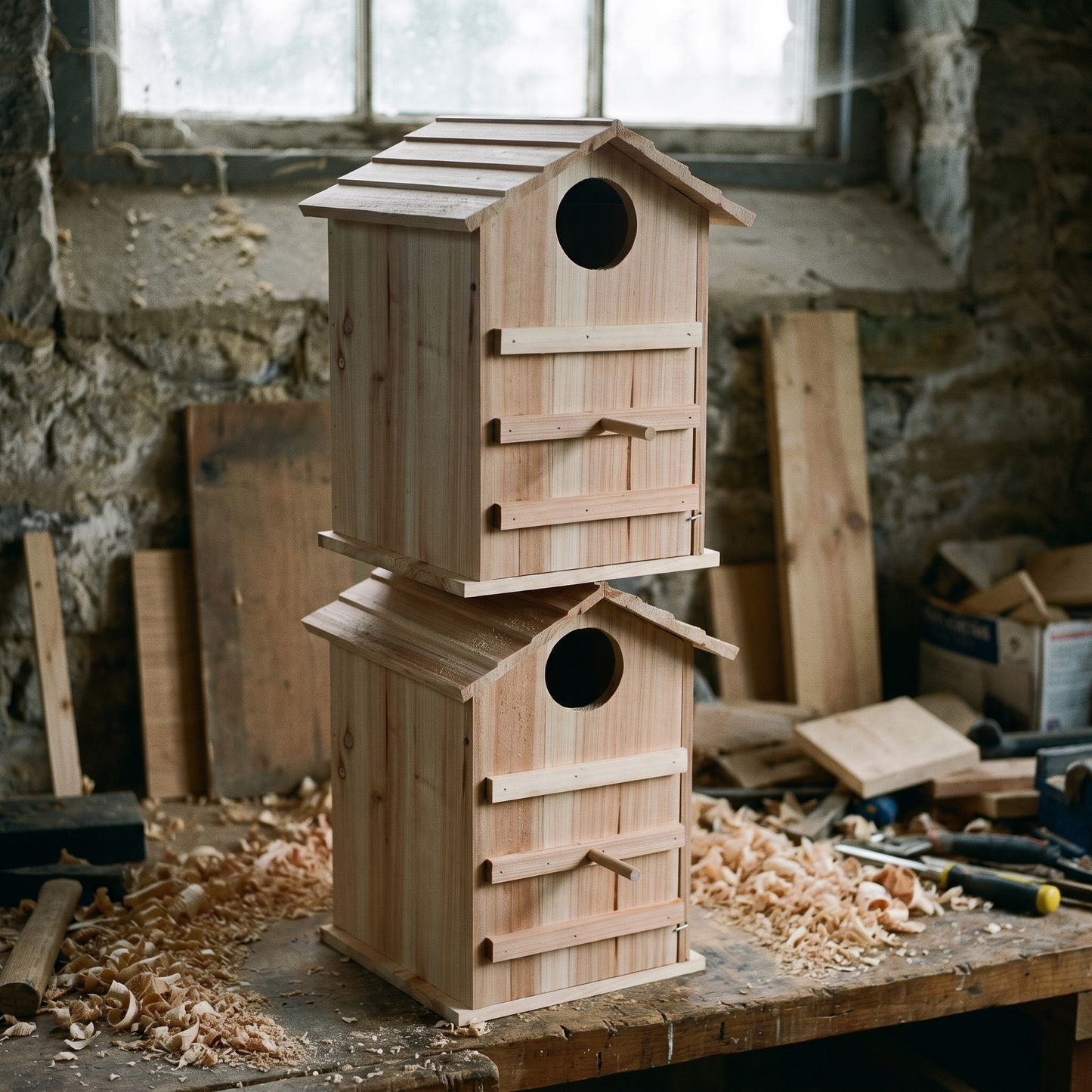
Ron's Hand-Built Owl Box
Ron's Hand-Built Owl Box
🐝 Gives wild bees a safe nesting home
🌸 3× more pollination than honeybees
🪵 Solid, untreated cedar — built to last
☔ Copper roof keeps tunnels dry
🌿 Chemical-free, natural materials only
Couldn't load pickup availability

Ron's Hand-Built Owl Box
Hand-built in the Frome Valley, Herefordshire
Ron Preece, seventy-four — forty-one years a BTO ringer, more than nine hundred owls in his notebooks. His lungs have ended the fine work. Sixty-three boxes are all that is left on the bench.
“A little owl doesn’t cut its own doorway. It takes what an old tree gives it — so I cut it one.”
What arrives at your door
Why a real owl uses it — and a garden-centre box sits empty
The entrance is bored to roughly 9.5 cm and set high in the face of the box, on a jig Ron made so every hole lands in the same place. Wide enough for a little owl to slip through, tight enough that it is not simply handed over to something bigger. The size and the height of that one opening decide whether anything ever moves in.
It is about 33 cm from the lip of the doorway down to the floor where the clutch sits. A magpie cannot lean in far enough and a grey squirrel’s arm stops well short. The deep ones raise owls; the shallow ones raise trouble.
Untreated, unpainted pine and nothing else. A treated box carries a chemical smell that reads as an alarm to a bird, and a painted one shouts “new” from a tree for three seasons. Bare pine breathes and weathers down to the same silver-grey as an old orchard limb.
The front swings down on a single fitted hook. A year of pellets and shed feathers comes out in about two minutes — no ladder-and-screwdriver argument. A bird passes straight over a box packed with last year’s mess; a clean one gets a new pair.
The inner wall under the doorway is left rough sawn, with a low ledge across it. Young owls leave the box before they can properly fly — on fledging day they climb that wall to reach the opening. A smooth interior strands them at the bottom.
Every box is cut, bored and grooved by Ron himself on a single worn bandsaw — most of a day of work in each one. No workshop crew, no machine stamping them out, and no second batch once the bench is empty.
“Little owls are secondary cavity nesters — they cannot excavate their own holes, so they depend entirely on old woodpecker chambers and natural rot in ageing trees. In Britain that habitat sat overwhelmingly in traditional orchards and veteran hedgerow trees, and we have lost the great majority of both. The national survey now puts little owls down by more than three quarters since the mid-1990s. A correctly built nest box is the single most effective way an individual can put that habitat back: the entrance has to be the right size and set high above a deep floor, the timber has to be untreated, and it has to open for an annual clean-out. A box that gets those four things right will be found and used where the birds still are. Most retail boxes get at least one of them wrong.”
Dr Helen Marsden, Ornithologist — Cavity-Nesting Birds
Marches Wildlife Institute
Perfect for
Quality you can check yourself
- Untreated weatherproof pine. No stain, no sealant, no paint — nothing that carries a smell a bird will refuse.
- Hand-bored entrance, set high. Roughly 9.5 cm, positioned well above the floor so nothing can work the hole from below.
- A genuinely deep cavity. About 33 cm from the doorway down to the floor, which is what keeps a clutch out of reach.
- A cleaning door that actually opens. Hinged front on a single fitted hook, so the box gets used for years rather than once.
- Rough-sawn climb-out wall. The detail nobody photographs and every fledgling needs.
30-day guarantee
If it is not right for your spot, email info@cedarandtinco.com within 30 days and send it back for a full refund. No fuss, no questions. UK delivery is free both ways.
Hand-built, so no two are identical. Grain, knots and the exact weathering will differ from box to box — that is the timber, not a fault. On occupancy, we would rather be straight with you: a nest box is an offer of habitat, not a booking. Whether an owl moves in depends on the birds being within range of you, on the surrounding land and on where you site it, and it can take a season or three. What is certain is the other way round: a bird that finds no hole at all has no chance. On species: the ~9.5 cm entrance suits little owls and other small hole-nesters. A tawny owl needs a considerably larger opening and a barn owl needs a much bigger box — this is not the right box for either.
Product details
| Material | Untreated weatherproof pine, iron mounting bracket |
| Finish | Bare sawn timber — unpainted, unsealed, weathers to silver-grey |
| Overall size (H × W × D) | approx. 38.5 × 25 × 28 cm |
| Interior (H × W × D) | approx. 33 × 18 × 21 cm |
| Entrance | approx. 9.5 × 9.5 cm, set high in the face |
| Weight | approx. 1.3 kg |
| Suitable for | Little owls and other small hole-nesting birds. Not suitable for tawny or barn owls, which need larger boxes. |
| Siting | Tree trunk or wall, 3–5 m up, entrance facing east or south-east, sheltered from prevailing wind and driving rain |
| Best time to put up | Autumn or winter, so it has weathered before the birds go looking in February |
| Care | Brush out once a year in late summer, after the season, through the hinged front |
| Made by | Ron Preece, Bishop’s Frome, Herefordshire — by hand, one at a time |
| Remaining stock | 63 boxes. There is no second batch. |