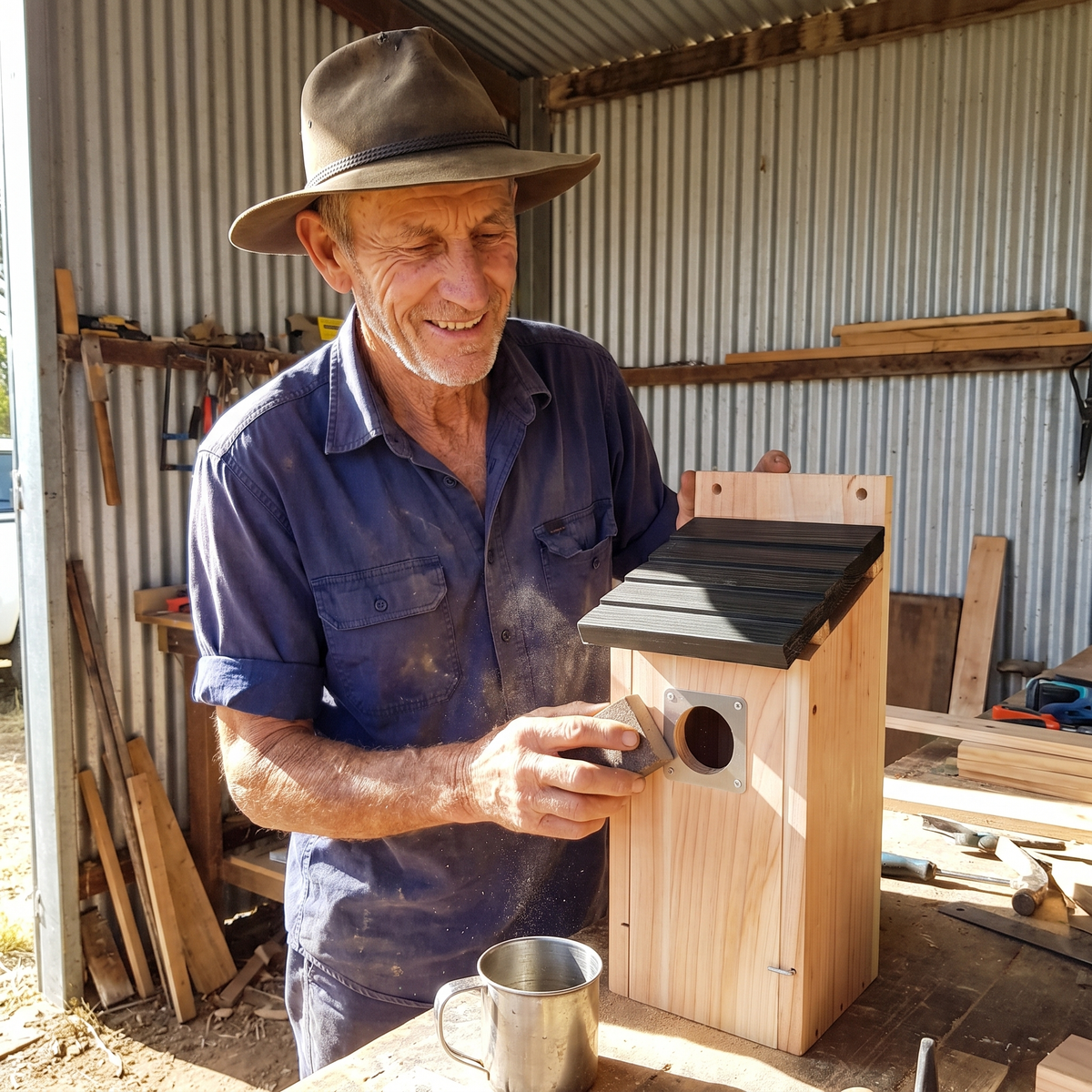
Trevor's Glider-Safe Cedar Nest Box
Trevor's Glider-Safe Cedar Nest Box
🐝 Gives wild bees a safe nesting home
🌸 3× more pollination than honeybees
🪵 Solid, untreated cedar — built to last
☔ Copper roof keeps tunnels dry
🌿 Chemical-free, natural materials only
Couldn't load pickup availability

Trevor's Glider-Safe Cedar Nest Box
Built by a Hunter Valley linesman who carried 212 gliders down the power poles
Trevor Maddock, 74, climbed power poles from 1969 to 2007 and kept finding sugar gliders in the electricity boxes, because their hollow trees were gone. Since 2008 he has built 1,140 glider boxes in his shed outside Paterson, NSW. His shoulders won’t take another ladder. These are his last 186.
“In February 1987 I opened a junction box on the Gresford Road and found seven sugar gliders curled up against the cables. I carried them down in my hard hat. The old gum with the hollows had been cleared the summer before. That week I built my first box.”
Trevor Maddock · Paterson, Hunter Valley NSW
What comes in the box
Fully assembled, ready to hang
Already fitted around the 38 mm hole
Long enough for a gum trunk
Up a tree in one afternoon
Why gliders move in and mynas don’t
A 38 mm door, a little smaller than a golf ball. Big enough for sugar and squirrel gliders, too small for Indian mynas, possums and rosellas.
A steel plate around the door. Cockatoos and lorikeets can’t chew the hole bigger, so the mynas can’t follow.
Grooves cut inside the front, under the door. Young gliders climb up and out instead of being stuck at the bottom.
Tall and narrow with the door near the top. Dark and snug inside, so a sleeping glider family keeps each other warm.
A raised wire floor lets rain run straight through. The bedding stays dry, even in a wet Hunter winter.
The front swings down and locks with a steel pin. Easy to clean out between seasons.
No perch on the front. “A perch is a step ladder for whatever wants to eat what’s inside,” says Trevor.
“Most nest boxes I take down are full of mynas or bees. Sugar gliders need a small, protected entrance and something to grip on the inside walls, so the young can climb out. A box like Trevor’s, hung three or four metres up a gum on the trunk, gives a glider family a real chance where the old hollows are gone.”
Sue Ellison · Volunteer wildlife carer · Maitland, NSW
Perfect for
Why Trevor’s boxes work
- 41 tries to get it right. Every detail answers a box that failed — to mynas, cockatoos or rain.
- Tested since 2008. 1,140 boxes up gum trees around the Hunter Valley before this last run.
- Real cedar. Naturally weather-tough timber that turns soft silver-grey over the seasons.
- No perch, no gimmicks. Nothing outside that helps a myna, a goanna or a cat.
- Ready the same day. Fully assembled with the steel plate fitted and two screws included.
Hang it, give it time, and if it isn’t right for your garden, one email to info@cedarandtinco.com is enough. No forms, no hassle.
Trevor’s one request. Screw it to the trunk, not a branch that sways, at least three to four metres up. Face it east, out of the hot afternoon sun. Gliders are shy at first — some families move in within weeks, others take a season.
Product details
| Contents | 1 assembled cedar glider nest box with steel entrance plate, 2 mounting screws |
| Material | Cedar, natural unpainted timber; dark slatted roof |
| Entrance | 38 mm round hole near the top, framed by a brushed-steel plate |
| Dimensions | Approx. 30 cm tall × 12.5 cm wide × 12.5 cm deep |
| Inside | Climbing grooves under the hole, raised wire mesh floor |
| Cleaning | Front panel swings down, locks with a steel pin |
| Best for | Sugar gliders, squirrel gliders, feathertail gliders |
| Where to hang | On a tree trunk, 3–4 m up or higher, facing east |
| Care | Check and clean once a year outside the breeding season. No paint inside. |
| Made by | Trevor Maddock, Paterson, Hunter Valley NSW — final run, 186 remaining |